.status-msg-wrap {visibility:hidden;display:none;}

dilluns, 26 de maig del 2014

MIXED TECHNIQUES: SUPERHEROES!!!

Superheroes and superheroines creation.

A superhero (sometimes rendered super-hero or super hero) is a type of hero or saviour possessing extraordinary talents, supernatural phenomena, or superhuman powers and dedicated to protecting the public. A female superhero is sometimes called a superheroine (also rendered super-heroine or super heroine).
By most definitions, characters do not strictly require actual supernatural or superhuman powers or phenomena to be deemed superheroes, although terms such as costumed crime fighters or masked vigilantes are sometimes used to refer to those such as Batman and Green Arrow without such powers who share other superhero traits. Such characters were generally referred to as "mystery men" in the Golden Age of Comic Books to distinguish them from characters with super-powers.

Some superheroes use their powers to counter day-to-day crime while also combating threats against humanity by supervillains, their criminal counterparts. Often, one of these supervillains will be the superhero's archenemy. As well, some long-running superheroes, such as Superman, Batman, Spider-Man and Iron Man, have a rogues gallery of enemies. As well, superheroes sometimes will combat such threats as aliens, magical entities, American war enemies such as Nazism or Communism, and godlike or demonic creatures.

While the word "superhero" itself dates to at least 1917, the term "Super Heroes" is a typography-independent 'descriptive' USA trademark which is co-owned by DC Comics and Marvel Comics.

We have created our own superhero...do you think they would save the world???


dimarts, 6 de maig del 2014

DIBUIX DE MODEL EN VIU NU

Amb els alumnes de 2n de Batxillerat d'Arts, dins l'assignatura de Dibuix Artístic II, hem realitzat unes sessions de dibuix de model nu.

El dibuix de nu, és un gènere artístic que consisteix en representar amb diferents tècniques artístiques (grafits, aquarel·la, pastels, carbonets, cretes, llapis Conté,...) el cos humà nu. El dibuix de nu és considerat artísticament com una matèria acadèmica o curricular, on les proporcions, l’encaix, les dimensions... sempre són un repte. Els cànons de dibuix que s’acostumen a fer servir vénen influenciats per estàndards erronis sobre la proporció i és quan un es troba davant del model on es pren consciència dels errors que s’efectuen quan es dibuixa l’ésser humà. Les sessions de dibuix de nu cerquen educar la mirada, per tal d’aprendre a observar. 


Aquí en podeu veure una selecció dels apunts de dibuix de 3, 5, 10 i 30 minuts.


divendres, 28 de març del 2014

DRY TECHNIQUE: LEAD PENCIL

Legend of Lead Pencil.

why pencil cores are called “lead”, even though they don’t contain lead??

In the 16th century, a large deposit of pure, solid graphite was discovered in Borrowdale, England.  This was the first time in recorded history that high quality, solid graphite had been found.  When metallurgists first encountered this substance, they thought it was some sort of black lead, rather than a form of carbon.  Thus, they called it “plumbago”, which is derived from “plumbum”, which is Latin for “lead”.

It didn’t take people long to realize that solid sticks of high quality graphite were good for marking things. At that point, this newly discovered substance from the mines of Borrowdale became extremely valuable.  So much so that guards were eventually posted at the entrance to the mine and laws were passed to stop people from stealing the solid graphite.  In addition, once a sufficient stock of the graphite was mined, the mine itself would be flooded until more graphite was needed.

Unfortunately, sticks of pure graphite are fairly brittle, so people started embedding it in various things such as hollowed out pieces of wood and also simply wrapped tightly in sheep skin.  Thus, the pencil was officially born with a core of solid graphite, which was known then as black lead.  The tradition of calling sticks of graphite “lead” has endured to this day.

We have been working with graphite pencils, using an enlarging grid and a black and white picture of a lion,  learning how true artists draw shadows and light...and it's been really difficult!!!
We hope you like it!


DIBUIX A PASTEL


DIBUIX A PASTEL
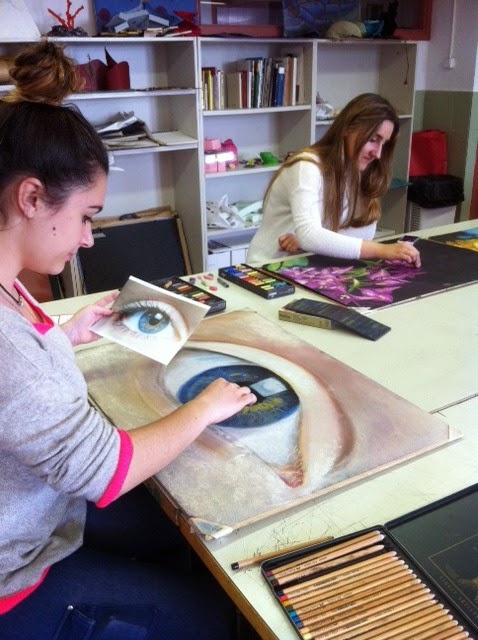
Els alumnes de Dibuix Artístic de 2n de Batxillerat  d’Arts hem estat treballant les nostres pròpies obres amb la tècnica del pastel i llapis de colors en format de 50x70 cm.
La Nerea ha treballat a partir d’una fotografia seva d’una flor groga. En Max ha volgut copiar una fotografia on hi surt  ell contemplant un paisatge d’Irlanda. La Paula ha volgut inspirar-se d’un fragment d’una poesia d’amor. L’Astrid ha volgut dibuixar l’ull de la seva mare i l’Anna ha dibuixat una fotografia que va fer ella d’unes bogambílies. Oi que són moooooolt xulos?

 
ASTRID SERRES
                               

NEREA CANO

    
ÁLEX GRANDE
ANNA MARÍN
MAX HERNÁNDEZ
PAULA GARCÍA
 Aquí us mostrem com treballàvem a classe aquests dibuixos.


dijous, 13 de març del 2014

MAQUETA "JARDÍ"

L'espai és un element aparentment abstracte, mesurable però immaterial. En la majoria de casos allò que
anomenem espai és un element que nosaltres generem o, per ser més exactes, que fem visible a través
de les construccions tridimensionals: instal·—lant elements, unint formes, posant límits… És a dir que podem crear espais.

Per entendre millor aquest concepte de creació d'espais i fer una aproximació al món del disseny d'espais, elaborem una primera maqueta, anomenada "Jardí", la qual ha de complir les següents condicions: ha d'aparèixer-hi un camí i tots els elements utilitzats per a la realització de la maqueta han de ser naturals.

Aquí en tenim unes quantes mostres:

                        Andrea Serdà                                           Cristina Llop


                       Helena Corominas                                     Clàudia Cela
      

FIGURES DE SABÓ

Una escultura volumètrica es pot treballar, bàsicament, a través de la substracció o talla de material o bé a l'inrevés: a través del modelatge o afegiment de material.
En aquest cas, els alumnes de 1r de Batxillerat han estat experimentant la precisió, cura i detall de la tècnica de la talla amb pastilles de sabó. La temàtica i les eines a utilitzar eren lliures i els resultats han estat els següents:
                           
                   Andrea Feliu                                                       Clàudia Cela
                   Cristina Llop                                                       Andrea Serdà
                                    
                  
                   Pablo Camacho                                                   Helena Corominas